Post School Pathway Planning
Futures
Post School Pathway Planning
I want to go to university directly after school
There are many ways to gain entry to an Australian university. However, the most common pathway for Year 12 graduates is direct entry from secondary school based on a student’s ATAR selection rank. Students can also gain direct entry to some university courses based on the results they achieve in specific subjects related to the course in specific Year 12 subjects.
What does ATAR stand for?
Australian Tertiary Admissions Rank
What is an ATAR and how is the ATAR calculated?
The Australian Tertiary Admission Rank (ATAR) is the standard measure of a student’s overall academic achievement in relation to that of other students. Its sole purpose is to help tertiary institutions select applicants for their courses.
The ATAR is a percentile rank, not a score, and indicates a student’s position relative to other students in their cohort in a given year. It is determined from the university aggregate score. The university aggregate score is calculated from the best four and a half (4.5) Stage 2 (Year 12) subjects. Each Stage 2 (Year 12) subject is marked out of 20, so the university aggregate is a mark out of 90. This mark out of 90 is then RANKED against all other students in that year and the students in the top 1% achieve an ATAR of 99.0, the top 10% an ATAR of 90.0 and so on. Further information about the ATAR can be found here.
What is a Selection Rank (SR)?
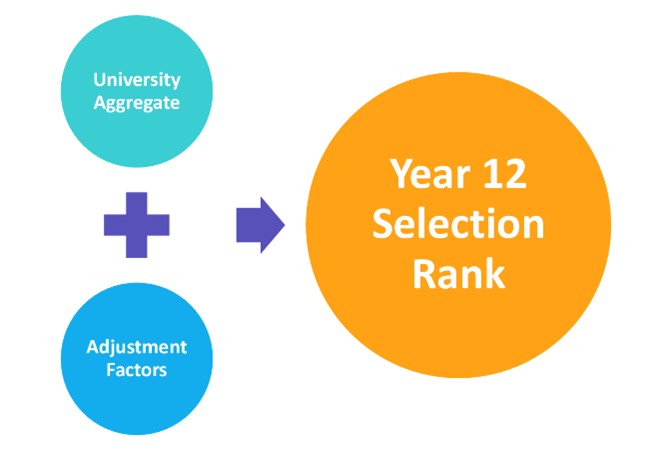
A Selection Rank (SR) is the score a student receives out of 90 as a result of their best four and a half Year 12 (Stage 2) subjects (university aggregate) plus any adjustment factors a student is eligible for.
Adjustment factors are added to the UNIVERSITY AGGREGATE (not the ATAR) and a new RANK is created, called the Selection Rank.
What are adjustment factors and how do they work?
Adjustment factors are additional ‘points’ that are used to calculate the SR. There are different adjustment factor schemes in every state and students must check each institution they are applying to, to determine if they are eligible for adjustment factors. In South Australia, there are two schemes to achieve adjustment factors; the Language, Literacy and Numeracy scheme and the Equity scheme. A maximum of 9 adjustment factors are possible for any student (5 for equity and 4 for subject based adjustments). Medicine and Veterinary Bioscience degrees do not accept subject based points for admission. For further information about adjustment factors, click here.
What are pre-requisite subjects?
Assumed knowledge subjects are Stage 2 subjects that a student is strongly ENCOURAGED to study for a particular course at a university as they will help the student to understand the content and it may mean a smoother transition to university. If a student does not study an assumed knowledge subject, they will still be eligible to be offered a place in the course, if they meet the ATAR/SR requirement for that course.
What is an assumed knowledge subject?
Assumed knowledge subjects are Stage 2 subjects that a student is ENCOURAGED to study for a particular course at a university as they will help the student to understand the content and it may mean a smoother transition to university. If a student does not study an assumed knowledge subject, they will still be eligible to be offered a place in the course, if they meet the ATAR/SR requirement for that course.
How do I know what subjects to choose to qualify for a potential tertiary degree or course?
Tertiary course prerequisites are different for each individual institution. Further differences exist from state to state. Students are therefore strongly encouraged to contact the individual institutions they are considering to get current information and/or visit their website(s) to gain up-to-date information.
What is scaling?
Scaling is a rigorous and unbiased mathematical process that allows for fair comparison of students’ achievements across all of their subjects.
It is a process that allows SATAC to compare the performance of students in every possible combination of SACE subjects. The data produced by scaling shows us how scores in one subject relate to scores in other subjects. SATAC uses the data to adjust or ‘scale’ subject scores to enable fair and accurate comparisons of student performance. For further information on how scaling works, click here.
Myths about scaling
Myth: Some courses are always scaled up (or down), therefore I should (or should not) study those subjects.
Fact: the way a course is scaled depends entirely on the average academic performance of all the students doing that course that year – and it can change from year to year.
Myth: I need to study ‘hard’ subjects to get high scaled scores.
Fact: ‘hard’ is a subjective term. Everyone has different strengths and interests. Students who achieve a high ATAR study a large variety of subjects.
What is Guaranteed Entry?
Some university courses have a guaranteed SR. This means that if a student achieves the guaranteed score, and they have the course in their preferences, and they have met all other admissions criteria (ie pre-requisite subjects, auditions, portfolios etc), they know they will receive an offer.
What is Early Entry?
Some interstate universities offer an early entry scheme, where students can apply to a university, using their Year 11 grades, and be given a provisional/conditional offer before they complete their Year 12 studies. To be eligible to receive the final confirmed offer, students must meet all pre-requisite subjects, complete their Year 12 studies and receive an ATAR.
Additional entry pathways
- STAT (Skills for Tertiary Admissions Test) – the STAT is an aptitude test that assesses a range of skills considered important for successful tertiary study, such as critical thinking, and understanding and analysing information. It does not test specific academic content.
- Flinders University UniTEST – UniTEST is an aptitude test that has been developed to assess the kinds of generic reasoning and thinking skills that underpin studies at higher education and that are needed for students to be successful at this level.
- VET pathways – students who have successfully completed a Certificate IV level VET qualification or higher, may gain entry to some university degree courses. Each university has their own criteria for selection through a VET pathway. Some Flinders University courses will also accept a Certificate III level qualification for entry.
I want to go to TAFE directly after school
TAFE SA is a vocational education and training provider that offers job-focused training across a range of industries from entry-level certificates to Bachelor degrees.
How do I apply for a TAFE course?
Students apply to TAFE through the South Australian Tertiary Admissions Centre (SATAC). Ranking is used for entry to competitive courses where class numbers are restricted. This may include the date of application or an audition or portfolio score. Many TAFE courses require students to complete the Snapshot Reading and Numeracy Indicator test (SRNI) or the Core Skills Profile for Adults (CSPA) as a course admission requirement.
Are there pre-requisite subjects for TAFE courses?
Generally speaking, there are no pre-requisite subjects for you to study at TAFE. Some courses have Course Admissions Requirements (CAR) or require you to study a lower level course (Certificate II or III) to apply for a higher-level course (Certificate IV, Diploma or Advanced Diploma).
What is the CSPA?
Can you use a TAFE qualification to apply to University?
Yes. A Certificate IV or higher qualification can be used to apply for many university degrees (In South Australia, some Flinders University courses will also accept a Certificate III qualification). Often, if the course is in the same ‘area’ of study, a student may apply to receive some credit towards their degree through Recognised Prior Learning. A student can also apply for a ‘Dual Offer’ course, where they will be accepted into both a TAFE course and a university course at the same time.
I’m interested in a trade. Can I start my post school pathway while still at school?
Yes, you can do an Australian School-Based Apprenticeship (ASBA) in Year 12, while completing your SACE. The details are worked out for each individual situation, negotiated between the student, the school and the employer. Generally speaking, students would be at Pulteney three days a week studying three Stage 2 subjects, and spend two days a week with their employer. The study component of the apprenticeship is often taught in blocks of time, sometimes in school holidays.
For further information about pathways to university or TAFE, please visit the Pulteney Futures website or contact Ms Leeanne Johnston-Bryan, by phoning 8216 5553 or via email at leeanne.bryan@pulteney.sa.edu.au